Archive | Recipes RSS feed for this section

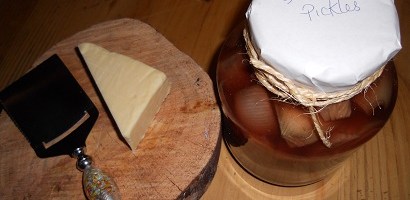
‘Blow your socks off’ Christmas Pickled Onions

18 Nov

I have always liked making my own stuff for Christmas (as you may have gathered) and even when I was working full time in the West End of London, I still spent weekends holed up in my kitchen for hours pottering about, cooking, preserving and pickling.  Sad I know (but it didn’t stop me meeting the man of my dreams aged 41!).  Anyhow, one thing I love at Christmas more than any other time, are really strong pickles on Boxing Day with cold turkey, cheese or game pie.  So does everyone in our family so even if you think you have bought enough, you never have!   So, I started making great big jars of them, and then losing the will to live after peeling a couple of pounds of small onions or shallots.  A couple of years ago I thought why not just use very fresh and crispy large onions that you would normally use in cooking.  I peeled about 5 or 6 large ones, and then quartered each one, and then cut the quarter in half.  Some of the outer layers come away, but so what?  They were are roaring success so I made our Christmas ones on Sunday – any pickles really need to be made about 6-8 weeks ahead, but if you do them this weekend, they will be fine for Boxing Day!  Be warned though, using onions does make them very spicy and because you don’t remove any of the chillies from the pickling spice, even more so!


You can make whatever quantity you like really so just decide on how many jars you will use – a huge old pickled cucumber one, or a few ordinary pickle jars.  Whatever you decide, for around 2 kgs of onion you will need 25 gms of pickling spice and 1.5 litres of vinegar or maybe a little more.  Malt vinegar is good, but I used cider vinegar this time – it isn’t quite so sharp.  You could try red wine vinegar too.


Cut up your onions and put half in the jar, followed by good teaspoon of the pickling spice, top up the jar with more onions and spices and then pour over the vinegar right up to the top and seal with the lids.  You need to store them in a cool dark place for several weeks before eating.  Voila!

 

Chocolate Cornflake Crispies

10 Nov

We are hosting our 5 year old half Spanish godson’s birthday party here this afternoon.  He has invited all his little Spanish mates – twelve of them – Yikes!

We thought we would provide half English and half Spanish fare – just to show how integrated we are!


In the past I have found it tricky to find the perfect Crispy recipe – they are either rock hard or too sticky – anyway, I found some time ago a Nigel Slater one – they give you the perfect balance of both and Mick has been testing them out since yesterday afternoon so I have had to make another batch!


For a rainy afternoon indoors with the kids, you will need:-


15 Paper Fairy Cake Cases


50g butter

4 Tablespoons of golden syrup (or very slightly less)

100g good quality dark chocolate

75g Cornflakes or Rice Crispies


Very gently melt the butter, syrup and cornflakes in a smallish heavy pan. Stir in the cornflakes.  Place spoonfuls of the mixture in the paper cases and refrigerate for a couple of hours if you can wait that long!  Absolutely sensational.


Watermelon and Mint Sorbet

2 Nov

I absolutely hate wasting food, and even though I love watermelon, I am sorry, who can eat a whole one unless you have hoards of children or are in the army!

So a few weeks ago, at the height of the watermelon season here, I was given two.  There aren’t really that many things you can do with them either so we ate as much as we could and then I decided to adapt a sorbet recipe for the rest.  The result is fantastic and you can adapt the recipe to whatever fruit is in season.  Even though we are on the edge of autumn here, I think after a hefty warming main course, this is lovely with some fresh pineapple and mango to follow without making you feel like hibernating.


You will need


Half a water melon (or just use your judgement with whatever fruit you are using –obviously the higher the fruit content the tastier it will be)

Half pint of water

6 oz sugar

A good handful of fresh mint


Dissolve the sugar in the water over a gentle heat, bring to the boil and simmer for 5 minutes.  Whiz up the watermelon and mint together until it is all slushy.  Then combine with the syrup and put into a plastic container and freeze.  If you can, take out every half an hour and give it a good stir, do this about 3 or 4 times if possible.

When eating, take out of the freezer 20 minutes beforehand otherwise it is difficult to serve without the use of a chisel!


Pickled red cabbage

31 Oct

As it is Halloween and I am feeling all autumnal and we awoke to a blustery old day, Mick took Kevin and Digby (the mutts) out early for a walk whilst I made coffee to take back to bed with some cook books as we had the extra hour.  I suddenly realised after looking through a couple of my books that if I didn’t get a move on, I would be too late to pickle the red cabbage for Christmas!  I am joking of course, but pickles do need time to absorb the spices so you need to make them at least a month before you want to eat them.  Mick always groans as November approaches because he knows, even though we live in Spain, I will start nagging him to sort out my Christmas playlist on the ipod!  I just can’t help it once the intense heat of the summer is gone I start planning for the festive season (of course we don’t have Guy Fawkes night to break it up!).  Well, I digress, but since it is the right time in the UK to start pickling and preserving, I thought you might like to know how to make some of the stuff I have at Christmas.  Also, if you start early, by the week before Christmas, you can put your feet up and enjoy watching everyone else rush around like lunatics!

You will need:

Pickling Spice (see below)

2 pints vinegar – recipes usually specify Malt, but I think it is quite strong so in my opinion you can use whatever vinegar you have, red or white wine, cider, even sherry.  In this recipe I have used cider vinegar.

Red Cabbage shredded

1 level tablespoon of coriander seeds

If you want to make life very easy, you can just buy the sachets of pickling spice from the shops, but if you like, you can just see what you have in the cupboard (coriander seeds, yellow mustard seeds, dried red chillies (about 5-10), allspice powder, ginger, black peppercorns and bay leaves (1-2).  Just put a tablespoon of the seeds, a teaspoon of the powders and for the chillies, just use what I suggested above depending how spicy you want the cabbage), and the two bay leaves, into a saucepan.

Bring to a simmer very slowly (about 10 mins) and then remove from the heat and leave to cool and infuse for a few hours.

Strain the vinegar into a bowl reserving the spices, stir in the red cabbage (about half a cabbage makes two medium sized kilner jars) and add the coriander seeds.  I used the beautiful little jar of them that my sister painstakingly bottled for stocking fillers at Christmas time last year from the plants at her allotment, and am so happy to make use of lots of them!  She is so clever and creative and all the things she makes are so much nicer than stuff you buy and look like they have come from Fortnums – she has been on a jam and chutney fest in the last few weeks – can’t wait for mine!

Ok, back to the cabbage.  Spoon it into your kilner jars, or old pickle jars and cover completely in the vinegar – there should be enough but if not just top up with the kind you used.  Then put a few of the chillies from the strained spices in – be warned though if you use too many the cabbage will be really really hot!

Seal and store in a cupboard for at least a month, preferably two.

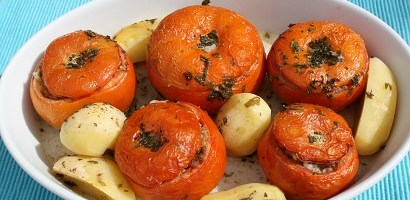
Armenian Style Stuffed Tomatoes

18 Oct

As you all know I just love cooking, but am probably guilty of doing what lots of us  do and that is stick with the same recipes because of lack of time and because I know I don’t often have time to leaf through my books for hours when there always seems to be so much else to do here. So I love it when I am given a recipe from another lover of food as I know I don’t have to test it!


Mick came back from a London trip, having had dinner at one of his clients (and now very dear friends), James and Vera Harland.  Vera is from Armenia and is the most fantastic cook (actually so is James).  Anyway, as usual when either Mick or both of us go around to their house for dinner, Vera had produced a feast, usually consisting of about a million different courses and one of the dishes was stuffed tomatoes, Armenian style.   Mick came home raving about them, so I asked Vera for the recipe.  Here they are for you – they make a lovely, tasty dish for lunch or supper and although they need a while in the oven, they can just be left cooking away happily while you go and do something else.  Also, if there are any vegetarians in your party, you can still serve tomatoes, but leave out the meat and put aubergines, pine nuts and raisins instead.  In fact this recipe can be adapted to your taste, put a bit of chilli in there if you like


For four people for part of a main dish, you will need


500 gms beef mince

Half a cup of Arborio rice

8 medium to large beef tomatoes

Olive oil

6 large potatoes peeled and cut into chunks

Dried Mint

3 or 4 large cloves of garlic

Lots of salt and pepper


Cut the tops off the tomatoes and scoop out the flesh and put to one side.

Turn the tomatoes upside down to drain as much liquid from them and retain the tops

Wash the rice and place in a bowl with the mince and mix in.

Chop up the tomato flesh in to small pieces.  Add to the mince mixture and add a good glug of olive olive and mix up.  Season with quite a lot of salt and pepper – it does need to be well seasoned.

Fill the tomatoes with the mixture but don’t over fill – pop the tops back on and then keep the liquid from this mixture.

Add 2 tablespoons of olive oil to a roasting tray and put in the tomatoes and peeled potatoes between them.

Sieve the reserved liquid over the dish pushing as much through as possible with a spoon

Peel and chop the garlic (use as much as you like!) and dot it all over the dish

Throw loads of dried mint over and cover with foil

Put in a moderate oven (gas mark 3/325F or 170C) for 3 hours – it will stay a bit longer if you wish

After 2 hours or so have a taste and re season with salt and pepper – remove foil for the last half an hour before serving on hot plates with lovely crusty bread.


Lemon Marmalade

26 Sep

I have always liked lime marmalade, but when we moved here there seemed to be a bit of a dearth of limes with which to make it.  So instead I started making lemon marmalade as we have a lemon tree outside my kitchen (although I do have to go lemon scrumping occasionally as there aren’t enough on my own tree!).  Anyway, lemons in the UK are cheap enough and if you want to have a go, it is really rewarding and incredibly delicious as well as easy peasy.

All you need is very large cooking pot to put on the hob.

Here is my recipe adapted from an orange marmalade recipe.

900 gms of lemons, plus one additional one

2.25 litre of water

1.35 kg granulated sugar (most recipes ask for 450 g more but I think it is too sweet so

I just boil it for longer in order to get the set)

This should yield around 5 or 6 450 g jars, maybe a bit less because of the increased amount of boiling.

Put the water in the pan and then cut the lemons in half – juice them and add to the pan, and then, here is the boring bit, cut all the peel up into small strips and add these to the pan too.  It takes ages so just put the radio on, listen to your favourite programme and get on with it!  Any pips or pith that is left on the squeezer put into a little square of muslin or a small fine handkerchief, tie up and suspend in the liquid.  Simmer the whole lot for an hour and a half and then put three saucers into the freezer.

After the simmering time, remove the little bag and shoot the sugar in and stir over a low heat.  Make sure that all the sugar is dissolved before increasing the heat.  Squeeze all the stuff out of the little bag – it contains pectin and will help the setting.  As soon as the mixture starts to boil you can start timing.  But watch it carefully now as when it gets to a rolling boil, it can boil right over – if this starts to happen just turn the heat down for a couple of seconds.  After 20 minutes or so, take one of the saucers from the freezer and drop a teaspoon on the saucer.  Put in the fridge for a few minutes to cool and then push with your finger.  If it wrinkles it is ready.  However, I find that because I don’t put as much sugar as usual recipes, I tend to carry on with this testing every 20 minutes another two times.  Don’t be tempted to bottle it if you don’t get to the wrinkly bit as it will just be liquid when it cools!  When you are ready, just leave in the pan for a while to cool a little before bottling in sterilized jam jars.  To sterilize pop in the oven in a moderate oven for 10 minutes.  Cover with waxed discs, seal and then when completely cold put the labels on.

Enjoy the next morning on some lovely fresh toast.

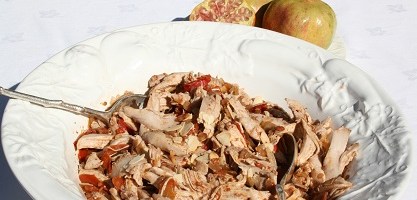
Morrocan Honey Chicken

16 Sep

A while ago I included one of my favourite recipes for pomegranate cous cous by Rosie Lovell (if any of your friends love cooking, buy them Spooning with Rosie for Christmas – it virtually never goes back on my bookshelf, but lives in my kitchen and just moves around so I can leaf through it while having coffee or chatting with mates who pop round) – this is the main dish with which to serve it – not only is it utterly scrumbo but it will feed an army without breaking the bank and looks stunning for a dinner party.  We often have 10 around our table at the cortijo and so is just brilliantly easy to cook and serve as the chicken can be made early that day or even the day before.  Make the cous cous an hour before your guests arrive and make up some chickpea puree – basically make a hummus without the tahini and add a gently fried onion and a good handful of coriander all whizzed up.  So, back to the chicken.

For an army you will need 2 hens, for six people 1 will be plenty – if I am cooking for six I don’t halve the rest of the recipe as I love the sauce.

2 Hens about 1.5 kg each

3 bay leaves

4 teaspoons whole cloves

2 teaspoons whole peppercorns

2 tablespoons olive oil

4 medium onions

2 teaspoons ground cloves

2 sticks cinnamon

2 bird’s-eye chillies

6 cloves garlic

1.2 kg fresh plum tomatoes

5 tablespoons of runny honey

freshly ground black pepper

Maldon sea salt

Put the chicken in two seperate large pots of water (or one if you have a massive pot).  Add bay leaves, whole cloves and peppercorns.  Bring to the boil and put a lid on and simmer for an hour and a half – the meat will be amazingly succulent and fall off the carcuss.  Take out of the stock and set aside for a couple of hours to cool.  Keep the stock for the cous cous (see my pomegranate cous cous recipe) and also for adding to the sauce.  You can freeze the rest for soup as there is so much of it!  When the chicken is quite cool, just pull all the meat off – it is brilliant as there is very little wasted, not true when you roast a chicken!  Then make the sauce.

Warm the olive oil in a very large pan and add the onion, peeled and chopped.   Fry with the ground cloves, cinnamon and finely chopped chillies.  Then peel and crush the garlic and add that too.  Sweat these ingredients gently – you don’t want it to brown.  Then roughly chop the tomatoes and add these to the pan.  Slow cook the whole lot with a lid on for a hour or so and then ladle in a  little of the reserved chicken stock to make a bit more saucy!  Then add the honey and then the stripped chicken, and season with salt and pepper.  If you are making this in advance just bring out of the fridge to room temperature and warm through just before serving with the cous cous.  Sensational!

Pomegranate Couscous

9 Sep

One of the things I love about living in a Mediterranean country is the ability to go and pick more unusual things off trees, particularly when cooking certain favourite recipes.  The other day I was driving over to a friend’s house at Desert Springs golf club and I decided to take the back road.  I am glad I did as on the way, past the village of Las Cunas, I passed an enormous pomegranate tree.  I was so excited as the tree was absolutely laden with fruit ripening in the late summer sun.  It was situated outside someone’s gates, but clearly was benefiting from being watered, so in effect I would be pomegranate scrumping!  However, one person could not eat all this fruit and so I decided it would be alright to share! 

I only picked a couple as I wanted to make sure they were ready and off I went, vowing to take Mick back with me if they were.  So when I got home I cut into one – the jewels were paler than normal, but the fruit was ripe and absolutely delicious.  We went back on Tuesday evening and picked a whole basket load, whilst keeping an eye on the guard dog who was barking his head off!  A tiny tub of pomegranate seeds here is a couple of quid so this added to my delight!  

I have two of my best friends arriving tomorrow night and will be making one of my favourite dishes by Rosie Lovell (Spooning with Rosie) – Moroccan Chicken with Pomegranate Couscous and chickpea puree.  It is just gorgeous and one chicken will feed six of you.  Anyhow, here is the recipe for the couscous part. If you want the chicken recipe, leave me a comment and I will include it.

400g flaked almonds

1.5 litres chicken stock or vegetable bouillon

5 coffee cups of couscous

Ground black pepper and Maldon sea salt

1 pomegranate

Scatter the almonds in a frying pan and toast until golden (just a couple of minutes should do it)

Remove and tip onto a plate or they will continue cooking

Heat the stock to simmering point – put the couscous in a large bowl – poor over the stock and make sure the grains are covered by about 5 cms.  Cover with cling film and leave to absorb for at least 20 minutes.  Fluff with a fork and season.  Then take all the (free!) pomegranate seeds without any pith and scatter these and the flaked almonds over the couscous.  I guarantee once you have made this you will make it at least half a dozen times a year.  It is a fantastic dinner party dish as everything can be done in advance, looks stunning and doesn’t cost the earth to feed a dozen people.  This would also go brilliantly with spicy lamb or fish.

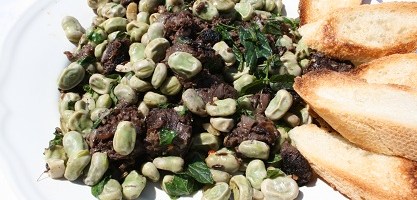
Habas y Morcilla

4 Sep

A few years ago we drove to Yecla, around 3 hours from here, for no other reason than to meet up with our friend James Harland who was attending a furniture exhibition there.  He is a good client to the spanish and always gets invited to various conferences or exhibitions here.  Yecla is full of furniture manufacturers and other than that not really noted for much else to my knowledge.  So we collected James from the exhibition hall and headed back into the smallish town and just happened upon an unspectacular looking, but busy, restaurant. 

We had not been in Spain very long so were still unsure of quite a lot of things on menu’s, particularly in towns which were in the heart of the countryside or mountains, which Yecla was!  Anyhow. we looked at what the local business people were eating and I immediately spotted something delicious looking on the next table so I motioned to our waiter that we would have lots of that please to start.  It was simply the most delicious thing I had eaten in ages and consisted mainly of Morcilla and Habas – black pudding with broad beans.

We scoffed a huge plate between us and I can’t even remember what we had to follow it was so good.  When we returned home I looked in my Moro cook book and to my delight I found the exact recipe.  So here it is for you – even if you think you don’t like Morcilla, give it a go, it is so yummy.  Have it for lunch or supper – it takes 15 minutes to make.  Perfect.

3 tablespoons olive oil

200 g morcilla cut into slices

2 cloves garlic sliced

Half a teaspoon of fennel seeds (you do need these so don’t be tempted to leave them out!)

1.5 kg broad beans – if you haven’t got an allotment just use frozen ones!

100 ml chicken stock

A good handful of fresh mint chopped

sea salt and black pepper

In a pan heat the oil and fry the morcilla on both sides for a few minutes -then remove and set aside

Add the fennel seeds and garlic to the pan and cook for a minute or two.  Add the beans and the stock.  If you can be bothered or have a lot of time on your hands, you can peel the broad beans and discard the skins – quite often I lose the will to live by doing this but the end result is perfection.  Simmer for 4 or 5 minutes.  Then throw in the morcilla and the mint, season with salt and pepper and serve with toasted brioche or some nutty brown toast.  To make this a more substantial dish, you can serve with scrambled eggs. Just divine.

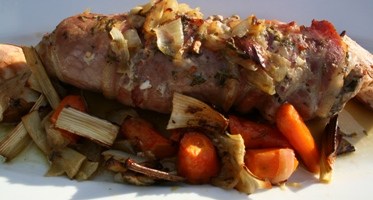
Arista (Roast rack of Pork)

23 Aug

Sunday and Mick and I have a precious day alone.  We have a little bit of work to do for the arrival of more guests on Monday but generally it is a day of pottering and some lazy time in the morning to decide what I will cook for dinner.  I always cook from scratch even if there are just the two of us and so I sit with a coffee and a wonderful cook book which my sister bought for me sometime after we moved here.

It is called Twelve – A Tuscan Cookbook by Tessa Kiros.  But that’s not Spanish I hear you cry.  No it isn’t but of course the climate is very similar and so are the ingredients.  I love it – it is seasonal too so that really helps sometimes.  However, I really fancied a roast type dinner tonight and so went straight to February!

The pork here is fantastic – really good quality and I never seem to go wrong with it.  Actually I didnt’ have a rack of pork – I had a solomillo or fillet to you.  But I knew it would work just as well, just a little less cooking time (do watch it though as the fillet will cook fairly quickly so check it 30 minutes after the browning bit).   So you will probably need to go to the butcher and ask for a rack of pork (just like a rack of lamb).  Ask the butcher to chine it for you otherwise it makes carving difficult.  You can also look up chining on Google if you feel like having a go yourself!  If you can’t be bothered then do as I did and just get a lovely fillet of pork – the size you get depends on how many you are cooking for but around 1.5 kg will feed 5-6 with some leftovers.  If you are using a fillet, it is easier to judge by eye how much you will need as you will be slicing it up.

Ingredients

1 fillet or rack of Pork

zest of one lemon

Some slices of bacon, pancetta or palma ham

1 onion chopped

2 carrots chopped

2 celery stalks in pieces

A good slug of white wine – a couple of glasses

Half a cup of olive oil infused with sage, rosemary, thyme and garlic all chopped up and left for a while in the oil

Pre-heat the oven to 200 C/400F/Gas mark 6

Rub the fillet all over with the oil and herbs – just do it with your hands

and scatter the lemon zest over

Wrap up in slices of bacon or whatever you are using and secure to the bones by tie-ing with kitchen string

Give a good grinding of pepper but no salt as the bacon is enough

Drizzle olive oil on to a roasting dish and place the pork in

Put the vegetables around the meat

Brown the meat for 10-15 minutes each side and then slosh in the wine and reduce the heat to 180c/350 f/Gas mark4 and continue to cook for up to an hour, turning occasionally and basting with the juices – you can add a cup or so of water if it looks like it needs it as it doesn’t want to dry out

Then remove from the oven and stick a skewer through to make sure it is cooked through – the juices must be clear.  Leave to cool and then carve if a rib or slice if a fillet.  I must say if you are not a confident cook then use the fillet as it is so easy and looks and tastes fantastic.  If you have the rib just cut into chops as you would a rack of lamb.